Welcome to Ms. Mya’s Classroom! This website is a toolkit for all things education!

Category: Free Inquiry (Page 1 of 2)

This is the category to apply to your Free Inquiry posts.

Inquiry Project- Week 10

Through these beginning stages of learning ASL, the biggest things I have learned are:

  1. That ASL has its own grammar
  2. Using your dominant vs non-dominant hand/arm matters

As of now, here is my list of ASL terms that I know!

  • Hi
  • My name is___
  • Eat
  • More
  • All done
  • Want
  • Water
  • Bathroom
  • Play
  • Toys
  • Ball
  • Help
  • Stop
  • Go
  • Wait
  • Yes
  • No
  • Please
  • Pencil
  • Question
  • Read
  • Quiet
  • Listen
  • Thank you
  • Mom
  • Dad
  • Grandma
  • Grandpa

Plus more! I also learned the whole alphabet- which I think has been very beneficial for when I do not know a specific sign.

Inquiry Project- Week 9

This week’s post was suggested to me by Michael! During our semester reflection meeting, he asked if I had found any text-to-sign resources, which I had not! Until that point, I had not even thought about it! Michael sent me this app called “Hand Talk” which I downloaded from the App Store.

Screen recording of the Hand Talk App translating “Hi my name is Mya”

This app allows you to type in a word or sentence and it animates the sign for you. You can also move the character so you can see the sign from different angles and slow the animation down. I am curious to know how accurate the app is. From my knowledge, it looks pretty reliable but my foundation is limited. This resource would be super beneficial in a pinch.

Inquiry Project- Week 8

This week I took a look at some resources that can be put in classrooms to get kids curious about ASL.

This poster can be bought on Amazon but there are many sites that sell similar ones. I even saw some free ones for download on Teacher Pays Teachers! This could be put in a classroom to build curiosity and awareness.

I also found some flash cards that could be put in a classroom game area for students to explore! These flash cards have words and pictures so it will also help with vocabulary, reading, and spelling!

I had an idea that Bingo could be a fun way to learn ASL. The boards could have letters or other signs written down and the teacher does the sign so they have to recognize the sign!

Inquiry Project- Week 7

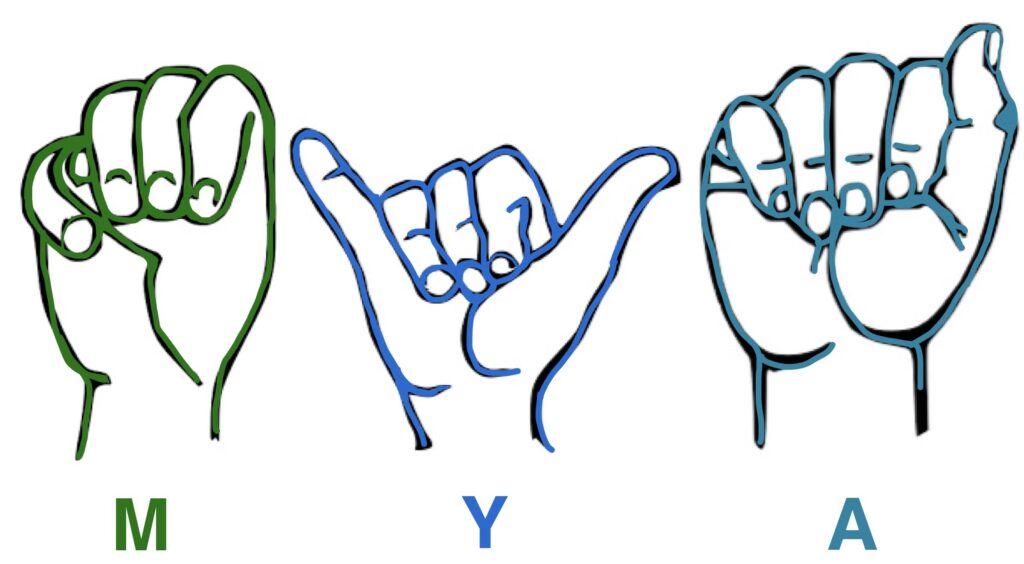
I used GoodNotes to create this finger spelling name graphic!

This could be a fun activity to do in a class room. The teacher can print out the appropriate amount of letters and have students cut out, glue, and decorate their name. This would get students learning their own name as well as their classmates!

The original black and white outlines can be found on Wikipedia!

Inquiry Project- Week 5

Today I am going to highlight different ways sign language can be used in the classroom.

Alphabet and Letter Sounds

Using and learning ASL while developing or reviewing letter sounds provides a visual/kinetic aspect for kids to understand.

Non-Verbal Communication with Teacher

Students can communicate basic phrases like “bathroom” or “water” so teachers and students do not have to communicate verbally. Teachers are often swarmed with questions so learning sign language can help negate the overwhelming environment that teachers deal with.

Expand Students’ Learning

ASL is a language that is not talked about in schools. Incorporating real signs, rather than made-up symbols, expands student’s world-views.

Communication and Self Regulation

Students can use ASL to communicate non-verbally to communicate feelings. Sometimes verbal communication can be too overwhelming and difficult. If students know basic signs, then they can communicate without having to speak.

Inquiry Project- Week 4

Hello! This is me signing Hello, My name is Mya, Yes, No, and Please! These signs were all very simple and make sense when thinking about the word. “Yes” is like nodding your head, while “Please” is like rubbing your heart!

On another note, I had an exciting ASL experience last week at work! My participant did not come to the swim program I work at so I was just standing on the pool deck. My coworker was across the pool and finger spelt “C-L-E-A-N” to me to ask me to clean up our equipment. I was able to understand her and it was very exciting for me!

Thanks for reading!

Inquiry Project- Week 3

Hello!

This week I have been focusing on basic, conversational ASL signs. This includes:

  • Hello
  • My name is…
  • Yes
  • No
  • Happy
  • Sad

These are just some examples of signs that I think will be beneficial to know. This week, I have also been learning about important things to know about ASL. This video by Learn How to Sign on YouTube, explains 10 things that beginners should know about American Sign Language. I learned that ASL is different around the world (hence it being called American Sign Language) and it is not the same as English as it has its own form of grammar. ASL also goes beyond the hand signals! Facial expressions, signing space, and use of your dominant hand are just as important. The video also explains the parameters of sign which are:

  1. Hand shape
  2. Palm Orientation
  3. Location
  4. Movement
  5. Non-manual signals

Hand shape is the importance of the correctness of form while palm orientation refers to where your hand is facing. Location is where the sign is being performed and placed. Movement signifies the importance of clarity of movement in a sign (ex. Is it a circular movement? Patting movement? Rubbing movement?). Lastly, non-manual signals is the body movement and facial expressions that coincide with sign language.

I am continuing to try to understand how sentence structure works in ASL. This video by the same channel does a great job of explaining the basics.

Next post I will demonstrate some of my new signs and hopefully start incorporating appropriate facial expressions and body language.

ASL Sentence Structure Explained | American Sign Language for Beginners. (2021). YouTube. Retrieved October 3, 2023, from https://youtu.be/fDV9Al8Fgjk?si=Zyw4UkU9gcxpRbV3. 

Learning ASL? Learn This FIRST!!! (10 Things You Need to Know About ASL). (2020). YouTube. Retrieved October 1, 2023, from https://youtu.be/6w1ZDaE-whc?si=At8qo6FgDsLd-jUT. 
Inquiry Project- Week 2

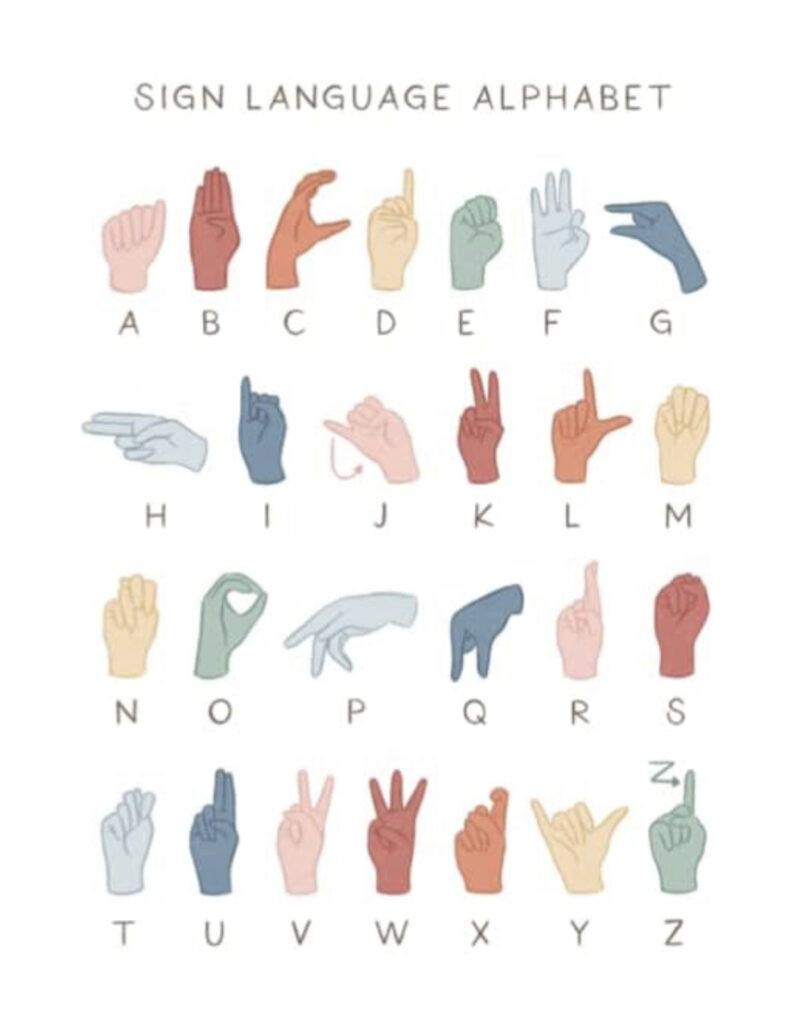
This week I focused on learning and memorizing the American Sign Language alphabet! I chose to start with this because I think it is important to be able to finger spell your name and be able to read other’s! I started by following this video on YouTube (it was the first one I watched and it ended up working very well for me). The young girl from the channel, Our Berg Life, does a great job of visually and audibly explaining each letter. The repetition made if very easy for me to remember. I learned half of the alphabet one night and the other half the next night so it was less overwhelming, but I am sure it would be easy enough to learn in one go. Once I had a grasp on all 26 letters, I referenced some different alphabet charts to confirm I was doing it properly and I was correctly taught. I might still be making some mistakes so please inform me if I am incorrect!

I have caught myself constantly practicing and going over the alphabet. Hopefully this practice with improve the smoothness of my transitions. Some of the letters are a bit tricky to sign, which was something I did not expect! I am super excited to continue with ASL over the coming weeks!

EASIEST way to learn your ASL ABCs | Slowest alphabet lesson. (2017). YouTube. Retrieved September 25, 2023, from https://youtu.be/a5BD8SjhPSg?si=TmrQYLxd9SeVxd-E. 

Inquiry Project- Week 1

An inquiry project allows for so much freedom. There are so many directions I could take this project and the possibilities are endless. With that said, I have decided to take on the task of expanding my American Sign Language (ASL) knowledge. I have learned a few basic signs from coworkers, but not nearly as much as I would like.

Here is a list of what I currently know in ASL:

  • Bathroom
  • Water
  • Eat
  • Help
  • Want 
  • More
  • All done
  • Mom
  • Dad
  • Grandma
  • Grandpa
  • Play
  • Toys
  • Stop
  • Go
  • Wait 

I have started incorporating these signs into my work as a coach and support worker at Canucks Autism Network. It expands my communication skills and helps me connect with more individuals. Even if the individuals do not know sign language, adding a visual motion to my verbal communication can help participants understand. 

To hopefully help with retention and fluidity, I will be breaking my lessons into categories such as family members, toys, school related, personal phrases, and the alphabet. I hopefully will be able to find some online resources in the coming weeks to start practicing and learning! On top of expanding my ASL repertoire, I hope to learn the history of sign language and where it came from!

« Older posts